
A new reader joined us this month, Doug from Lander, Wyoming. Lander is about 25 minutes from Riverton, which is where I graduated from high school. And Jim’s wife is from Lander, so it was definitely old home week.
Doug has about 4,000 books in his house, which can be a real pain in the butt when someone moves as often as Doug has. Like several of us, Doug took a test in 7th grade to determine his reading capability: 300 words per minute, and that was before they enrolled him in a speed reading class. 600 wpm after class. Like Michael, Doug has traveled all over the world (19+ countries, almost all work related), so he had some great stories. Looking forward to seeing him again.
And Christy joined us after a long absence.
Jim and Michael rejoined us after missing our Mother’s Day edition, along with Cynthia, Beth, Peggy and Linda, so all in all a pretty good group.
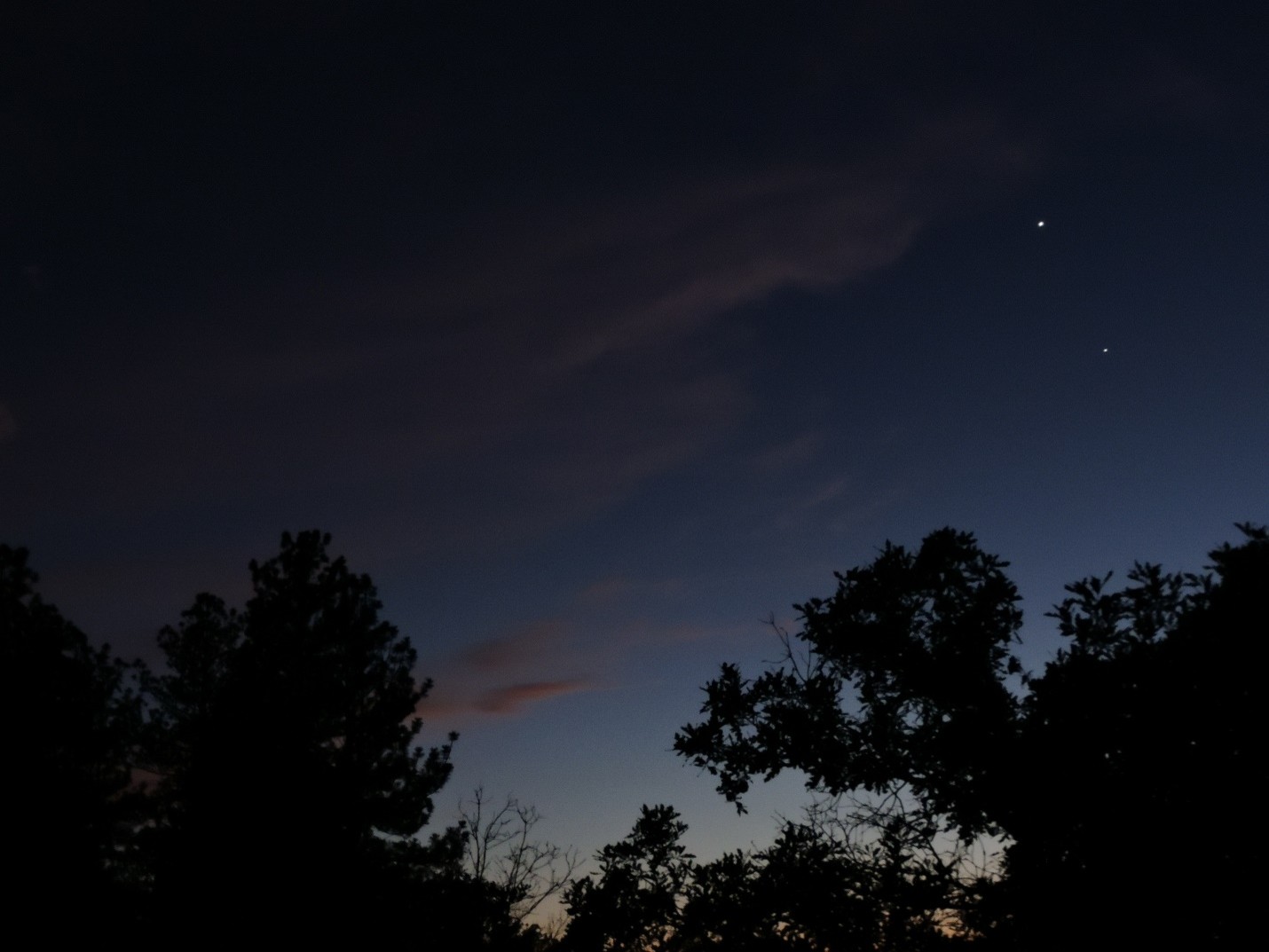
Beth took a cool picture from her front porch of Venus and Jupiter at dusk. Amazing that this was taken using a hand-held camera.
Cynthia recently returned from her visit to the Mayo Clinic; she travels there every three months to have her eyes checked. She now sees a kaleidoscope out of the corner of her eye, which I think is pretty cool. It apparently occurs as a result of her Charles Bonnet Syndrome.
We haven’t heard from Ben in a long time (seems like years) but he did pass this along to be shared with fellow Book Lovers. I think this is a neat idea, a good way to promote independent bookstores.
“The Nebraska Book Trail is a summer passport adventure inviting readers to visit independent bookstores across the state, discover local communities, and collect punches for a chance to win prizes.” The program started on June 1 and lasts until September 30.
Christina sent in the list of books she listened/read to in January/February. She’s had some serious physical problems which limits what she can do, so we appreciate her taking the time to compile this list.
I also received a nice email from Caroline. She plays organ on Sundays, so never has a chance to join us in person. Turns out she got married last August 31st. “Two is a charm,” she wrote. We wish you only the best, Caroline. She also passed on what she has been reading lately. Those books are listed below.
If you’re looking for inspiration on what to read next, Goodreads has come out with their Readers’ Most Read Books of the Reading Challenge (So Far). Quite a few older titles on this list. Maybe other readers are like me; I add something to my (TBR) list, but then it takes me a long time to finally read down to it. I think my Libby wish list is somewhere around 2,300 titles. And now I’ve added three more, based on this article. Sigh.
The full list of the 63 books reviewed/discussed can be found here:
https://www.mamensa.org/category/book-lovers-sig-book-talks/
Book Lovers SIG always meets the second Sunday of each month; our next get together will be July 12. We meet online using Zoom, so it is easy to join us. Folks generally start checking in around 2 p.m. for a bit of socialization. Book discussions begin around 2:30 p.m., more or less, or when Peggy says, “OK, let’s talk about books!”.
To join us on Zoom, simply click on the link shown below:
https://tinyurl.com/BookLoversSIG
You can also open your Zoom app and use these parameters:
Meeting ID: 946 0436 4344
Passcode: 844358
*****
Caroline
What I’m planning to read is indicated with a * notation.
A Book of Lives, a Memoir of Sorts by Margaret Atwood
The Plumed Serpent by D. H. Lawrence
Eleanor Roosevelt by Blanche Wiesenthal Cook *
My Name Is Andrew Lev by Chaim Potok *
Angela’s Ashes by Frank McCourt
The Life and Works of Paul Klee by Linda Doeser
Ornamentation in J.S. Bach’s Works by Putnam
Marc Chagall by Ingo F. Walter
Linda
Girl Dinner, by Olivie Blake 2* A ridiculous book about a sorority that kills men and eats them.
The Keeper, by Tana French 4* The latest in the series about Cal Hooper, the retired Chicago cop who now lives in a small town in Ireland. He solves mysteries and mentors a teenage girl from a dysfunctional environment. This story was about solving a possible suicide or murder of a young woman. It involves local politics and schemes and was a little overwritten on those topics. I loved the ending, however.
Everything is Tuberculosis, by John Green 5* An eye-opening book about how widespread TB still is, especially in the poorer countries of the world. Some statistics, some stories of sympathetic individuals struggling with the disease. It still kills 1.25 million people every year. Who knew?
Tokyo Express, by Seicho Matsumoto 3* A traditional mystery first published in 1958. Totally plot-driven, it involves a supposed suicide investigated as a possible murder. The details involve a lot of transportation logistics, focused on whether a person could have been in a particular place at a certain time. Interesting insights into Japanese life at that time, when long-distance travel was all by train and ferry and long-distance communication was by telegram.
All That is Secret, by Patricia Raybon 2* Set in 1922, a young black woman returns to her hometown of Denver to investigate her father’s death. Awkward writing style and too much religion to suit me.
Timber Creek K-9 Mystery series by Margaret Mizushima 4* (Someone else may have reported on this series.) I got hooked on this series and have been binging nonstop, can knock one off in a day or so. About a small-town female deputy who solves crimes with her trained German Shepard. I enjoy the characters especially the dog who uses a variety of skills. It’s set in Colorado so that’s an additional plus. There are 11 books so far; I’ve read 8 of them. The first is Killing Trail.
Exit Strategy, by Martha Wells 4* Murderbot heads home to rescue Dr. Mensah from the GrayCris corporation.
Reality Winner: I Am Not Your Enemy, a memoir by Reality Winner 4* Autobiographical telling of the NSA whistleblower who leaked too much top-secret information and was then given the longest prison sentence of anyone convicted under the Espionage Act. A lot of insights about the history of this Act, and enlightening information about the corruption of the legal system and the prison system.
Severance, by Ling Ma 3 A post-apocalypse novel, where the world is devastated by a fungus infection that causes people to become basically zombie-like and then die. The main character is a Chinese American young woman and much of the book is about her earlier history before the plague. An ambiguous ending resulted in my 3 rating.
We The People, by Jill Lepore 3 I finally finished this doorstop! Very long and dense — a lot about the amendment process and those who used and misused it. It did win the Pulitzer, but I must give only 3 based on its lack of readability.
Yours Truly, by Abby Jimenez 4* Second in a series, totally chick lit but I liked it. An ER doc is not happy about the new guy who gets the job she wanted. You can probably write the rest yourself but chick lit is fun now and then.
Doug
The Essential Scalia by Jeffrey S Sutton and Edward Whelan *****
This non-fiction book is a collection of (sometimes abridged) legal opinions, speeches, and articles by Antonin (“Nino”) Scalia. I found it very interesting, probably mostly because of my interest in constitutional law as a check on the misdoings of the legislative and executive branches of the U.S. government, both of which seem to be prone to various kinds of errors, blunders, misconduct, malfeasance, and constitutional illegality, and for the constraint and guidance of lower courts. It reinforced my faith in the Constitution and the supporting processes by providing insight into how the Justices arrive at a basis for a legal decision, and how they should determine the meaning of the text of the law in question. Scalia’s writing style is clear and understandable while being free of legal technicalities, and his analogies provide context and further explanation for his opinions.
I doubt that casual readers will be interested in the book, unless they have some appreciation for the relationship between the Supreme Court (SCOTUS) and their everyday lives.
The Subtle Art of Not Giving a F*ck by Mark Manson ****
Manson is said to be a popular blogger who has tried to condense the thousands of “life” questions (wealth, possessions, beauty, sex, etc.) he receives into a way to manage what you care about. His point is that we need to think more clearly about what we think important is in life, and then what we should choose to think is unimportant. He says pursuing something (a positive experience like becoming wealthy, having a rocking beach body, having 20,000 friends on Facebook) just reinforces the fact that you lack it in the first place (a negative experience).
Manson makes some very good points, although his conversational writing style and occasional redundancies sometimes caused me to reread paragraphs to make sure I understood what he was writing. It is a good book, though, and I’m going to read it a second time to see what I missed or misinterpreted.
Don’t Make Me Think! A Common Sense Approach to Web Usability by Steve Krug. This is the computer user interface design book that I mentioned after the meeting.
Peggy
Platform Decay, by Martha Wells. Eighth in the Murderbot series. And after seeing the Apple TV series, Murderbot now looks like Alexander Skarsgard, instead of the androgynous being I originally saw it as. After volunteering to run a mission to rescue members of Dr. Mensah’s family, Murderbot realizes that it will have to spend significant time with a bunch of humans it doesn’t know. Including children. Ugh. This may well call for… eye contact!
Brawler, by Lauren Groff. Moving across age, class and region, among those we see in this collection of short stories are a poor young woman suddenly responsible for her disabled sibling; a hot tempered high school swimmer in need of an adult; a mother blinded by the loss of her family in a disaster; and a spoiled brat of a banking family trying to redeem himself.
The Last Mandarin, by Louise Penny and Melissa Wang. Alice Li, a first-generation Chinese American, is a food blogger who lives in the shadow of her famous mother, Vivien, a Chinese dissident and activist. When alarms go off simultaneously around the world, the signal is traced back to China. Vivien and Alice are called to the White House in hopes they can decode the Chinese intentions. Fast-paced and nobody dies in Three Pines.
The Keeper, by Tana French. The third book in the Cal Hooper series opens in the Irish village of Ardnakelty, where the body of Rachel Holohan—once poised to marry into a powerful local family—is found in the river. Retired detective Cal and his fiancée are drawn into a tangle of small-town grudges, schemes, and loyalties.
Theo of Golden, by Allen Levi. This book club favorite follows a well-to-do elderly Portuguese man who comes to the small Southern town of Golden and buys a café’s portrait drawings and gives them to their subjects. Each gift forges new bonds, tells hidden stories, and reshapes the town’s sense of community. Multiple surprises at the end — some sweet, some sad.
The Vanishing Cherry Blossom Bookshop, by Takuya Asakura. This novella takes readers into a store that appears only during cherry blossom season, where Sakura and her calico cat meet visitors carrying unresolved grief. Each arrives drawn by a book that links past and present. The Little Prince and Peter Pan and two Japanese novels are the linking books.
Beth
Innocent Mage, Karen Miller. A civilization composed of two groups, the mages, and the ordinary folks are living on a relatively small peninsula in the age of horses. There is a burning wall of fire between two mountains that keeps all the bad things away. The kicker is how the king (or queen) is the weather worker and must perform weather magic regularly to make the ‘rains’ come and to keep the fire wall burning. There are lots of rules that make things harder, so there is lots of competition. Into this mix comes a first-born son who doesn’t have magic, a daughter (unprecedented second heir) who does: the succession is always an issue. Then an ordinary person (Olken) looking to make his fortune catches the prince’s eye and becomes indispensable, even though he just wants to make some money to show off to his family when he returns to them. Things go sideways immediately, and there are lots of people with their own agendas.
A Gentleman in Moscow, Amor Towles. Many people have disappeared and more during the Russian Revolution. This is the story of some of them, told through the eyes of one non-person living in the Metropol Hotel through the wars, and the revolving cast of characters and how they negotiated the gulf between surviving, their dreams, and the changing rules. Sometimes, staying under the radar works, and causes the powers that be to look the other way, but you have to keep thinking, and never, never let them see you sweat.
The Gardener of Baghdad, Ahmad Ardalan. This is a story about a boy in Iraq who makes good as a master gardener, and falls in love with a British general’s daughter, a forbidden relationship. It is a love story set against the prejudices held by all sides during the fall of the malik.
Roadwalkers, Shirley Ann Grau. This story follows a number of characters through the south and the diaspora and how one black woman, whom we meet as a small child in the depression, makes a life for herself and her daughter.
The Mystics Scepter, Marie Andreas. This is book 5 in a series that includes all sorts of creatures and all kinds of magic as two groups fight against each other for control of the world. Just a lot of fun.
Backtalker, Kimberle Williams Crenshaw. Kimberle Crenshaw is a lawyer at the center of critical race theory and intersectionality. This is a telling of her life as a black woman growing up in Canton, Ohio, and the road she took. Most importantly she illustrates how she came to develop those two concepts. The whole flap about critical race theory and the lies that were told that this was being taught in grade school was a plan to eliminate any thought that challenged the patriarchy and the social order and the current hierarchy with white northern European men on top. Intersectionality is what happens when two (or more) competing ideas argue for inclusion where only a linear hierarchy is allowed. A black woman suing GM for discrimination lost her case because as a woman, other women were employed at GM (in white jobs), and black people were employed (in men’s jobs), and therefore she had no case. Although this woman was at the bottom of or excluded from those jobs because for the woman’s jobs, she was black, and for the black jobs because she was a woman. A further example is Clarence Thomas and his confirmation. If you expected him to be treated as a black, he insisted he was only a man, and if you expected him to be treated as a predatory man, he’s just a black man doing ‘down home’ courting. Black women get excluded and erased every time. When you start applying this template to other issues, it is everywhere and used to erase things that we don’t want to deal with, or things we don’t want to see.
Ancillary Sword, Ann Leckie. Book 2 of the Imperial Radch series. Anaander Mianaai is at war with itself. One Mercy ship escapes to the Athoek system, and the fun begins. Fleet Captain Breq Mianaai is in charge of exactly one ship, but also the whole system. This is a story about AI vs. Human, and who gets to decide things. Anyone can be the good guy or the bad guy, and all the power structures are vulnerable. Then the Praeger translator (Translation State) shows up and gets herself killed, there is a treaty with the Praeger, who have agreed to leave humans alone if they behave, or the Praeger will revert to destroying humans for the fun of it.
Ancillary Mercy, Ann Leckie. The story continues with some delicious twists.
Radiant Star, Ann Leicke. The Radchaai and a wandering planet come together in a slow-motion train wreck. This takes place at the same time as the Ancillary series (mentioned above). The Anaander Mianaai has split into factions and is having a civil war with itself, crashing the interstellar gates and disrupting all travel and commerce in the process. One Radch ship that is at the end of its useful life is in orbit around a wandering planet. The planet has lost its sun and is traveling in interstellar space. It is covered in ice with a liquid water ocean under the ice. A small population subsists in one city. Life revolves around religious sects and their saints, and against that background, the local politicians jockey for position against the competing sects and the Radchaai religion. Much wackiness and suffering ensue.
Cynthia
A Quitters Paradise by Elisha Chang. I read this as an attempt to reconcile the author’s problematic relationship with her dead mother, to weave together the disparate memories of her relationship with her mother, and to understand what her current circumstances are.
Gone Before Goodbye by Harlan Conan and Reese Witherspoon. An international crime drama that seems fairly predictable and is an easy fast read but finishes with a somewhat surprising ending.
Everything Is Tuberculosis by John Green. I found this book really interesting in its combination of historical and current facts, integrated with personal stories of tuberculosis patients and victims. It is a clear reminder of how important public health interventions are and the fact that most of us have some tuberculosis in our family histories.
The Demon of Unrest by Erik Larson. This factual history of the years leading up to the Civil War is told by including direct statements from the diaries and writings of people from both sides. The description of slavery and its inhumane horrors I found particularly impactful. It also details the long history of pedophilia by powerful men and their self-justification as well as institutional misogyny.
Michael
Year of Wonders by Geraldine Brooks. The year of wonders referred to is 1666 and the place is England and this is the year the Black Death, the bubonic plague, wiped out half the population. The story is about a village that voluntarily quarantined itself to avoid spreading the plague to its neighboring villages. This story is based on rumors that may, or may not, be true. Anna, the main character, makes herself useful by nursing the sick, helping to bury the dead, and providing whatever support is needed. The book is very well-written but a bit repetitive as one-by-one various characters succumb to the disease. Eventually, because so many people have died, the plague itself dies out, and things go back to a much reduced normal. I thought the horror of the disease was better described in Connie Willis’s sci-fi work, DoomsDay Book.
March by Geraldine Brooks. March is the story of Mr. March, the father of Jo, Meg, Beth and Amy March, the little women of Louise May Alcott’s famous book, and the year he spent as a conscientious objector, chaplain and teacher with Union troops in the early days of the U.S. Civil War. The book was very well researched and based largely on the life of Bronson Alcott, Louise May Alcott’s own father. Bronson was vegan, a pacifist, and a strong anti-slavery advocate, who was also friends with Henry David Thoreau and Ralph Waldo Emerson, who are also referred to in the book. There are harrowing descriptions of amputations in army field hospitals, a possible affair with a high yellow nurse, and much else all interspersed with heartfelt letters to and from Marmee and her girls. The book won the Pulitzer Prize in 2006.
Hag-Seed: The Tempest Retold by Margaret Atwood. Recommended by the Folger Virtual Book Club which specializes in Shakespearean works. An especially good read for a theatre person such as myself. A theatre group’s artistic director is cheated out of his job by ambitious underlings and his final production, The Tempest, then had to be cancelled. Twelve years later, the director, who has been running a theatre group in a prison, casting prisoners in all the roles, finds himself in the position of being able to put on his much-delayed production for these same underlings. It is an excellent opportunity for revenge.
The Daughter of Time by Josephine Tey. A wounded British detective is hospitalized for a lengthy period of recuperation. To fill the many boring hours, he must spend in bed, he decides to apply his detective skills to solve a 400-year-old mystery; was Richard III really the evil monster as depicted in Shakespeare’s play, or was he the beloved and respected monarch as described in contemporary writings of the time? The supposed murders of his two young nephews as mentioned in the play are at the crux of this problem. Contemporary writing culled from the British Library contain no mention whatsoever of these supposed murders, which would have been widely reported and scandalous if they had indeed happened. There are many other events and dozens of royal and court figures mentioned and investigated, and then the conclusion is that Shakespeare’s play was based on fabricated information. The book is fascinating but not an easy read. It’s like reading a very thorough but dry police report. The title is from the saying, “Truth is the daughter of time”, which means that eventually the truth about anything is revealed over time. Thus, after President Trump is no longer an active participant in American politics and it is no longer profitable for the many people assisting him in doing that, the truth will come out.
Oryx and Crake by Margaret Atwood. The first book of her post-apocalyptic MaddAddam trilogy. In a world that has been depopulated by an as yet unidentified pathogen, humanity has devolved into various tribes, one a revisionist Christian group of rabid ecological survivalists, one a dark and powerful group of scientists specializing in genetic mutations and pathogen development, and another in underground hedonistic behavior. Crake and Oryx are symbolic Adam and Eve figures in the evolving mythology. A book as prescient as The Handmaid’s Tale.
The Year of the Flood by Margaret Atwood. The second book of her post-apocalyptic MaddAddam trilogy. The world has been almost depopulated by an as yet not clearly described “Waterless Flood” (a global pandemic), and the book follows two friends from different groups described in the previous book as they try to survive in a worsening world. The book picks up where the previous book ends and the final book does the same thing.
MaddAddam by Margaret Atwood. The final book of her post-apocalyptic MaddAddam trilogy. There’s much fill-in of who-was-doing-what when this other thing you knew about was going on. Brings the whole story to a satisfactory end. As stated before, this is a prescient series because of what is featured in this book: DNA tampering, gene-splicing, attempts to create “better” humans, powerful secret government departments, etc.
A Carnival of Losses: Notes Nearing Ninety by Donald Hall. A memoir from America’s Poet Laureate of 2006-2007. It follows his earlier book Essays After Eighty and is filled with autobiographical episodes from his life including meeting with many famous people, mostly other poets and writers.
Caleb’s Crossing by Geraldine Brooks. A fictionalization of the story of the first Native American to graduate from the newly established Harvard University. Caleb willingly adapts to white culture and, despite prejudice, sheds his Native American persona and succeeds in becoming what we would now call white. An interesting story but with a disquieting undertone regarding treatment of Native Americans later in American history. Very well written as all of Brooks’ books are.
The Last Time I Lied by Riley Sager. Fifteen years ago, three girls disappeared from a cabin at an all-girls summer camp. They were never found and the camp closed down. Now, 15 years later, the camp has re-opened and three more girls have disappeared from the same cabin! The story is told from the point of view of the fourth girl who was an occupant of the cabin both times the girls disappeared. A very well-written mystery.
Contact by Carl Sagan. The book the movie was based on. I once co-taught a course called Film and Fiction in which we read six novels and then saw the films made from those novels. If I were to teach that course again, I would include this book/movie as it is an excellent example of how books must be adapted in order to work as a film. The story is about a radio message that is received all over Earth from a source near the star Vega. The message contains plans for building a huge machine, which seems to be a transportation device. Sagan fills the book with scientific details and theories and believable international government and religious complications. The book is well-written, and deep, so readers can find many ideas that Sagan treats at length in his later non-fiction book, The Demon-Haunted World. Sagan wrote an original treatment of the story in 1980-81 and published the book in 1982, from which the 1997 film with Jodie Foster was made.
Housekeeping by Marilyn Robinson. The lives of two orphans, Ruthie and Lucille, raised after their mother’s suicide, first by their grandmother, then by a couple of great aunts and finally by an aunt, who was, basically a hobo, addicted to staying in motion and not at home.
Python’s Kiss by Louise Erdrich. A collection of her short stories, most of which initially appeared in The New Yorker magazine. The stories include Domain and Asphodel, science-fiction stories about corporate controlled afterlives, Assassin and December 26, stories about the teen-age, real-life, public participation game, and also Python’s Kiss, The Hollow Children, Love of My Days, Borsalino, The Feral Troubadour, Big Cat, Amelia and The Stone.
Thinking in Pictures by Temple Grandin. An amazing and very informative book. In fact, a scholarly paper, complete with bibliography, covering the different types of autism, its causes and treatment, the author’s own specific type and her very important relationship with animals and their ethical and humane treatment. She makes strong arguments for animals’ ability to think and show emotion in many species. Almost a third of the animal slaughtering facilities in the U.S. incorporate her humane theories. On reading the book, you would not believe that the author is autistic, if she did not tell you and explain it at length.
Land by Maggie O’Farrell
The Poisonwood Bible by Barbara Kingsolver
The Invisible Life of Addie Larue by V.E. Schwab
Brad (57/19522)
Forfeiture by J.P. Nebra *** 322 p.
Earth is a mess. Pollution, global warming, species extermination. So indigenous peoples use ancient communication devices to send out a call for hep to the aliens that first visited earth a long time ago. The aliens arrive and give the world’s leaders one year to stop their destructive behaviors. Or else. You can pretty much figure out what happens next.
Fox Creek (Cork O’Connor #18) by William Kent Krueger **** 336 p.
A woman comes to Henry for help, but we soon learn that she is being tracked by killers and we don’t know why. In the meantime, Cork is trying to track down men illegally hunting on tribal land. And of course the two are connected. And of course Cork and his family become in danger themselves. Pretty much the standard plot at this point in the series, but still, it can entertain.
Platform Decay (The Murderbot Diaries #8) by Martha Wells **** 243 p.
Murderbot is on a mission with a handful of other humans to rescue someone on a station that appears to be in some kind of corporate war. The odds of success are not good. He finds the person they are trying to reach, but then the bad guys show up and there is a perilous escape.
Been a long time since a Murderbot book came out, so I really enjoyed it.
There’s Something Wrong with the Cats by C.J. Powell **** 307 p.
So, Dan’s two cats have gone missing from a quiet residential street. He puts up flyers and talks to his neighbors, but nobody has seen them. After about four days they return, but something is not quite right. One has noticeably put on weight. Maybe someone has been feeding them? Except that cat keeps getting larger, and bulkier. Muscular? Was someone giving it steroids?
It turns out other cats have gone missing as well. Quite a few of them, actually. Dan works from home, and has what appears to be a pretty flexible schedule, so he starts investigating what may have happened to his cats. He decides to keep his cats inside until he can figure out what is going on, but that doesn’t work out so well, because the cats freakin’ break out of his flat! That muscular cat has literally torn the cat door off its hinges. So, he decides to follow them; they end up leading him to an abandoned warehouse, where kidnapped cats are being used to bait dogs, which prepares the dogs for fighting, all being run by a crime syndicate.
It turns out his two cats have somehow managed to escape that warehouse and have hidden in the woods, where they drank out of a mysterious pool of water that glows at night. Apparently, the result of a crashed alien vessel. This liquid has given one cat incredible strength, and the other cat can now communicate telepathically with Dan, and eventually verbally as well.
This book was a real mishmash of ideas (themes). I’m not certain they all work together very well.
A Death in the Family by James Agee *** 244 p. I really didn’t like this book. I’m going to pull the description from Wiki to try and give it some justice.
“A Death in the Family is an autobiographical novel by James Agee. It was based on events which occurred to Agee in 1915, when his father went out of town to see his own father, who had suffered a heart attack. During the return trip, Agee’s father was killed in a car crash.
“Agee commenced work on the novel in 1948. It was still incomplete at the time of his death in 1955. It was edited and released posthumously in 1957 by editor David McDowell. Agee’s widow and children were left with little money after Agee’s death and McDowell wanted to help them by publishing the work.
“McDowell’s alterations include:
- The removal of the original opening, a nightmare scene, and its substitution with “Knoxville: Summer of 1915,” a previously published short work of Agee’s that was not intended as part of the novel.
- A reordering of the presentation of events, which were originally shown in chronological order.
- Chapters were removed.
- Chapters were divided.
- Certain chapters were moved and presented as flashbacks.
- The number of chapters was changed from forty-four short chapters to twenty.
It subsequently won the 1958 Pulitzer Prize for Fiction. I would pass up this version and read the original, unedited version, which was finally released in 2007.
The Nine: The True Story of a Band of Women Who Survived the Worst of Nazi Germany by Gwen Strauss **** 322 p.
Strauss was inspired to tell this story after hearing about her great aunt, who ended up being one of the nine women written about in this book. All of them served in the French resistance and eventually ended up in Ravensbrück towards the end of the war.
As the allies began their advance across Europe, the various concentration camps were closed down, and the prisoners were forced to march farther into Germany. It was during the march from Ravensbrück that the women were finally able to escape, finding a gap between the guards and hiding in a ditch until their column passed. What lay ahead of them was a journey of several hundred kilometers to reach the allied lines, relying on the underground and Germans who knew that the war was about to be over, so found it in their best interests to help the escapees, instead of turning them over to the Gestapo. Lots of grit, lots of determination.
Each chapter describes one of the women, what she did before the war, what she did during the resistance, the path she took after capture, and her life after the war.
The Last Commissioner: A Baseball Valentine by Fay Vincent ***** 336 p.
Fay Vincent truly was the last commissioner of Major League Baseball, a person whose responsibility was to act in the best interest of the game. He was driven out of office by Brewer’s owner Bud Selig, who then took over as commissioner. Selig only acted in the best interest of the owners, as has every commissioner since then, which is the main reason why there continues to be such labor strife. Expect another strike in 2027 when the contract with the players union is due to expire at the end of that year.
If you loved baseball the way I used to love baseball, then this is a must read.
Mickey7 by Edward Ashton ***** 288 p.
Mickey is in trouble. He has incurred some serious gambling debts and really needs to get off the planet. Only hitch is, there is only one way off, to get a berth on a settler ship heading for a new planet destined for colonization. And that ship is fully booked; the government is only selecting the best of the best to make this journey, and Mickey ain’t one of them. There is one slot left, however, that is as expendable. Someone who is willing to give up their life, then be regrown again each time he dies. Expendables are given the most dangerous tasks, because truly, their lives have no value. But Mickey really has to get off the planet, so he signs the contract and off he goes.
As the story begins, we’re now at the seventh cloning of Mickey. Off on another mission they have colonized, the colony just barely hanging on. He falls down a deep shaft and his pilot buddy, deeming it to risky to rescue him, leaves Mickey to die instead. But he doesn’t. Mickey is assisted in his escape by a life form no one was aware had existed and someone manages to make it back to the base. The only problem is, he has already been reported as dead and is greeted by a newly hatched Mickey8. Now is when the trouble really starts.
This was a great story to read. Recommended. Goodreads Choice Award Nominee for Readers’ Favorite Science Fiction (2022)
Rapport: Friendship, Solidarity, Communion, Empathy (The Murderbot Diaries #2.5) by Martha Wells ***** 34 p.
Although this is listed as a Murderbot story, Murderbot is not actually included as a character. Instead, the main character is Peri, a small ship that has brought a small group of humans to a space station caught up in a corporate war. It turns out, Peri seems to have fallen for a rogue Secbot. You can guess who that is.
A pretty good chunk of the story can be found here. Hugo Award finalist for Best Novelette (2026)
The Left Hand of Darkness by Ursula K. Le Guin *** 367 p.
Genly Ai, a human native of Terra, is sent to the planet of Gethen as an envoy of the Ekumen, a loose confederation of planets. Ai’s mission is to persuade the nations of Gethen to join the Ekumen. Which is fine, except Gethen is essentially an ice planet, and the nations that comprise it have rejected any advanced technologies. They don’t even have airplanes, but instead rely on walking, slow moving carts, or boats for transportation. There is absolutely no reason for the Ekumen to want to bring this planet into their confederation. And I just couldn’t get past this fatal flaw in the story.
Awarded the Hugo and Nebula Awards for Best Novel, 1970
A Psalm for the Wild-Built (Monk and Robot #1) by Becky Chambers ***** 151 p.
A monk has left his position no longer satisfied with his life in the monastery. He decides to become a specialized tea monk instead, one who travels from town to town, offering tea and a listening ear. He had a slow start, as he refused to become an apprentice at first, but over time becomes very good at what he does, and people queue up to see him when they hear he is coming to visit.
The only problem is that this new achievement has not calmed the thought that there must be something more. So, basically, he goes on walkabout.
Now. On the same planet, many hundreds of years later, the robots become sentient, and eventually an agreement is reached with the humans that the two should separate, each staying in their own territory. Except now the tea monk is entering that very territory, which no human beings have ever visited.
At the same time a robot has volunteered to leave their territory to visit the human side of things, to see what they are up to. The two meet and go on a journey with each other, supporting and learning from each other along the way.
I loved this book. Highly recommended. Goodreads Choice Award Nominee for Readers’ Favorite Science Fiction (2021). Hugo Award for Best Novella (2022)
Light Bringer (Red Rising Saga #6) by Pierce Brown ***** 800 p. This book is so immense, so all-encompassing, so filled with plot twists, there is just no way to summarize it. If you are a fan of the Red Rising series, this is a must read.
The seventh and final novel in the series, Red God, was supposed to come out this summer (2026), but has been delayed so that Brown can come up with the perfect ending. At last report he has already written over 1,000 pages. Really looking forward to it.
Goodreads Choice Award Nominee for Readers’ Favorite Science Fiction (2023)
The Savage, Noble Death of Babs Dionne by Ron Currie ***** 361 p. I am going to go with the Goodreads synopsis on this one. It tells you everything you need to know.
“Babs Dionne, proud Franco-American, doting grandmother, and vicious crime matriarch, rules her small town of Waterville, Maine, with an iron fist. She controls the flow of drugs into Little Canada with the help of her friends and oldest daughter.
“When a drug kingpin discovers his numbers are down in the upper northeast, he sends a malevolent force, known only as “The Man,” to investigate. At the same time, Babs’s youngest daughter, Sis, has gone missing, which doesn’t seem like a coincidence. In twenty-four hours Sis will be found dead, and the whole town will seek shelter from Babs’s wrath.”
All I can add is that this was a great read, a wonderful piece of fictional writing. Highly recommended.
The Searcher by Tana French ***** 464 p. This is one of those books that has been on my list to read for a while, and boy am I glad it finally came up.
Cal Hooper is a retired cop from Chicago, with 26 years of service in the police force, and he is done with it. His wife has left him; he barely talks with his grown daughter anymore. So he decides to get away as far as he can and purchases a run-down cottage in a small village in Ireland. The only problem is, what appears to be placid and peaceful on the surface isn’t as it seems. Soon he is drawn into a missing person’s case, and he discovers just how seemly perfect this small village really isn’t.
Great read. Highly recommended. Goodreads Choice Award Nominee for Readers’ Favorite Mystery & Thriller (2020)
Christina
For the Barnes & Noble January Theme, Time:
Here Comes the Sun by Bill McKibben. Read for the Pro-Democracy book club. Very engaging and full of information about current work in renewable energy and battery technology. Not overly optimistic but explains the politics involved and offers a glimmer of hope.
Who Was Jane Austen? by Stephanie Insley Hershinow. Read for Jane-uary. This is a short Great Courses presentation in the Audible Plus catalog. It puts a lot of Jane Austen’s life into historical perspective.
The Bell in the Fog by Lev A.C. Rosen. Strong sequel to Lavender House, with interesting characters and disturbing insights into queer life in the 1950s.
Emergency Skin by N.K. Jemisin. An interesting look at what happens when our distant future meets our not-so-distant future and learns a thing or two.
Once Upon a River by Diane Setterfield. Read for the Harmony Library book club. A beautifully layered tale of a girl fished out of a river and restored to life and how she changes everyone in the village.
My Lady, Will You Dance? by Sofi Laporte. Read for the Read Harder challenge. Sappy, predictable Regency romance. Not awful, just unremarkable.
Misery by Stephen King. Read for The Reader’s Cut Book Club. Surprisingly gripping story of a famous writer rescued, nursed, and then tortured by his biggest fan.
Life Ever After by Carla Grauls. Read for Buzzwordathon. Short science fiction story about two people who meet in a waiting room and their relationship over the years. Fell flat for me.
The Invisible Life of Addie LaRue by V.E. Schwab. Read for the Wolverine Farm Book Club, the High Tea Book Club, and the Mardi Gras Readathon. A young Frenchwoman flees an arranged marriage and makes the mistake of praying for protection after dark. The god who answers makes a deal with her, and we follow the aftermath for a few centuries. It’s mostly vibes, but I loved it.
The Mystwick School of Musicraft by Jessica Khoury. Read for the Mardi Gras Readathon. Yeah, the magic system doesn’t make a ton of sense, but this was a fun middle-school grade story of a flautist who gets admitted to her dream school, then finds out it was an administrative error. She then has a limited time to prove her worth or be sent home in disgrace.
The Pit and the Pendulum by Edgar Allan Poe. Read for Nevermore. A tale of the Inquisition. This one doesn’t really feel like Poe to me.
More Nevermore and Mardi Gras Reads:
The Cask of Amontillado by Edgar Allan Poe. My all-time favorite Poe story, full of bitterness and ambiguity.
Annabel Lee by Edgar Allan Poe. I don’t think I’d read this one since middle school. Very atmospheric and melancholy. I also enjoyed exploring some of the music inspired by it.
The Masque of the Red Death by Edgar Allan Poe. This one really holds up to re-reading, with different elements revealing themselves over time.
Well Met by Jen DeLuca. Read for the Folger Shakespeare Library’s book club. Fun romance at a Renaissance Faire, with a good story about family and friendship. Gets a little steamy, but that’s not the focus.
Cupcakes for My Orc Enemy: Sweet Monster Treats by Honey Phillips. Ugh. I went in expecting some cozy fantasy along the lines of Legends & Lattes but with some spice. Nope. Just straight-up orc porn with barely any plot to cobble together the repetitive sex scenes. I mean, if that’s your jam, here ya go. But not for me.
For Nathanuary, the rest of Young Goodman Brown & Other Short Stories by Nathaniel Hawthorne:
Rappaccini’s Daughter. Yes, the inspiration for Poison Ivy. A re-read for me, and it was interesting to see what new things I noticed this time.
Roger Malvin’s Burial. An odd story about the choice between duty and survival.
My Kinsman, Major Molineux. An interesting study in foreshadowing and how to pivot when faced with the unexpected.
For Diversity Book Bingo:
Walking Practice by Dolki Min, translated by Victoria Caudle. Read for the F*cked-Up Book Club. To be clear, this is a thoroughly disgusting story of a stranded alien who prefers to eat humans, usually after having sex with them. But I and my malformed, arthritic hips empathized with every painful step of its journey.
I’m Starting to Worry About This Black Box of Doom by Jason Pargin. Read for the Sword & Laser book club. Political thriller meets screwball comedy. Tries to be both meta and philosophical at the same time and doesn’t quite succeed, but there are some fun scenes.
Paradise by Laura M. Censabella. This is an LA Theatre Works production of a play about an ambitious Muslim girl and her cranky science teacher. There is a lot going on here, and it’s too on-the-nose for my tastes. It was also poorly adapted to audio. There was a nearly silent scene that I had to look up to find out what happened.
The Indigo Room by Stephen Graham Jones. A short story about the horrors of being a single parent in the corporate world. I think. It’s hard to tell though what SGJ is thinking sometimes.
Little Bird Laila by Kelly Yang, illustrated by Xindi Yan. A sweet picture book about a Chinese American family dealing with the language barrier.
More Kid Lit:
Umbrella over Berlin by Cao Wenxuan, illustrated by Pan Jian and Pan Ying. An umbrella goes on an adventure in Berlin. I liked the illustrations but thought the story was kinda weird.
Good Books for Bad Children by Beth Kephart, illustrated by Chloe Bristol. Read for the Read Harder challenge. This is a biography of Ursula Nordstrom, who wrote one of my childhood favorites, The Secret Language. I had no idea about her impressive career as an editor. Great book with lovely illustrations.
Remaining Fiction:
Lost Angels: Paradise High: Welcome to Paradise by David Accampo, illustrated by Chris Anderson. Issue 1 of 5 of a YA graphic novel series. It was interesting enough I’ll probably read the second issue.
The Last Assignment by Benedict Ashforth. A ghost story that I might try reading with my eyeballs, as the narration was distractingly bad, to the point I can’t tell you anything about the story.
A Study in Scarlet by Arthur Conan Doyle. Read for Holmes Is Where the Heart Is. I think this is my third reading of this. Thanks to Sir Derek Jacobi for getting me through the Utah section. Not the best Sherlock Holmes story but worth reading to see the famous duo come together.
Run for the Hills by Kevin Wilson. A man in a rented PT Cruiser drives around the country collecting his newly discovered half-siblings so they can confront their father together. Much wackiness ensues.
Ligeia by Edgar Allan Poe. Read for the Literary Love book club. Another Poe re-read. Mostly vibes and ambiguity, but I love it.


You must be logged in to post a comment.